
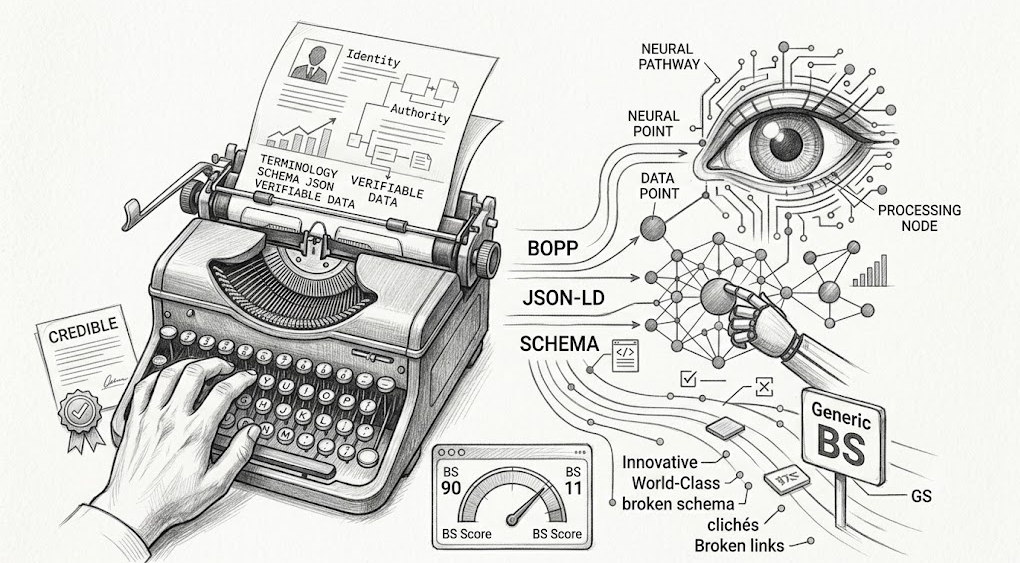
For years, websites were built for two audiences: human visitors and Google’s ranking systems. By 2026, a third and far more decisive reader has taken over — the Large Language Model. Systems like ChatGPT, Claude, and Gemini do not “view” a website. They ingest it as structured and unstructured data, evaluate its factual density, and decide whether the business behind it is credible or generic.
Understand Business LikeAI [dot] com was created to expose this process. It is a free, large‑scale forensic library — roughly 30,000 pages — built from real 1EuroSEO audits. Each page is a machine‑generated snapshot of a real company, showing exactly how an AI interprets its identity, authority, and narrative quality.
A Large‑Scale Forensic Benchmark of the Business Web
The platform functions as a public, permanent index of machine‑readability. With tens of thousands of cases across more than 50 industries, it provides a statistical baseline for what “credible” looks like in each niche.
Across this dataset, patterns emerge:
- High‑authority companies use specific terminology, verifiable data, and clean identity structures.
- Low‑authority companies rely on clichés, generic marketing language, and broken or missing schema.
This contrast is visible at scale. A business with an “11 BS” score sits beside another with a “90 BS” score, making the credibility gap obvious without interpretation or opinion.
Industry‑Specific Fingerprints and the Vocabulary of Authority
Because the library is so large, it reveals the technical vocabulary that defines authority in each sector.
In the printing industry, for example, terms like BOPP, thermal transfer, and white underprinting appear consistently in credible companies. Their absence is a signal of low expertise.
This pattern repeats across all industries:
- Medical devices
- SaaS platforms
- Manufacturing
- Legal services
- E‑commerce niches
The dataset shows what real expertise looks like in machine‑readable form.
From SEO to MCO: The Shift to Model Context Optimization
The platform introduces a concept that reflects the current state of the web: Model Context Optimization (MCO).
SEO was about ranking in a list of links.
MCO is about ensuring an AI model has enough structured, verifiable context to recommend a business confidently during a conversation.
UnderstandBusinessLikeAI.com trains users to see the signals that matter to LLMs:
- Clean Text
- Schema JSON
- Identity chains
- Proof links
- Review counts
- Industry‑specific terminology
By removing design, layout, and visual noise, the platform exposes the raw inputs that drive AI decision‑making.
The Four Forensic Pillars Behind Every Audit
Each page in the library is generated using the 1EuroSEO BS‑Indicator methodology. The system evaluates websites through four architectural pillars:
Information Density vs. Commodity Fingerprints
Does the site provide real data, or does it rely on generic claims like “innovative,” “world‑class,” or “customer‑centric”?
Semantic Drift
Do the sub‑pages support the claims made on the homepage, or is there a narrative mismatch?
Authority Gaps & Identity Integrity
Is the Schema JSON‑LD complete, nested, and verifiable?
Are experts, authors, and entities properly defined?
Objective Trust Signals
Are there external proof links, review counts, and verifiable references — or only unsubstantiated promises?
These pillars determine the BS Score and reveal the structural strengths or failures of each business narrative.
A Hands‑On Calibration Environment
Each training module follows a strict three‑step flow:
- Raw Input — the exact text, headings, schema, and signals the crawler extracted.
- Human Diagnosis — users attempt to identify weaknesses and BS patterns.
- AI Verdict — the official 1EuroSEO audit is revealed for comparison.
This process trains users to recognize:
- Missing identity chains
- Broken semantic hierarchies
- Low‑density content
- Overused templates
- Unsupported claims
It is not a theory lesson — it is calibration through exposure to thousands of real cases.
A Public Record of Digital Quality
The platform operates under a permanence policy.
Each audit is a point‑in‑time forensic snapshot and remains part of the public dataset.
Low scores are not removed. Instead, businesses can correct their structural issues and resubmit for a new evaluation.
This creates a transparent, accountable record of digital quality — similar to a credit score, but for machine‑readable business identity.
Conclusion: A Practical Roadmap for the AI‑Driven Web
As AI systems increasingly mediate discovery, trust, and recommendations, the aesthetics of a website matter less than its machine‑readable substance. UnderstandBusinessLikeAI.com provides a large‑scale, evidence‑based environment where anyone can study how AI interprets real businesses.
By analyzing thousands of forensic cases, users learn to avoid the BS Trap, strengthen their digital identity, and build websites that both humans and machines can trust.