
The Semantic Anchor is a protocol‑level identity extension for the llms.txt standard. It directly addresses the structural “Identity Gap” identified on 07.04.2026 — the absence of a verifiable entity layer linking llms.txt declarations to a canonical source of truth.
Why This Matters
The current llms.txt format is readable but not verifiable.
It describes content, but it does not prove who is making the declaration.
The Semantic Anchor introduces a single, mandatory header that binds llms.txt to a canonical JSON‑LD identity resource, enabling:
- structured identity resolution
- token efficiency
- persistent entity coherence
- machine‑readable provenance
- zero duplication and zero drift
The Header
Identity: https://example.com/identity.jsonld
This header must appear at the top of llms.txt.
It binds the text file to a canonical JSON‑LD identity node.
Reference Implementation: 1EuroSEO.com
1 Euro SEO is the first production deployment of the Semantic Anchor pattern.
The official, production files are live:
The GitHub repository contains reference copies only:
- canonical-llms.txt
- canonical-identity.jsonld
These exist for documentation, versioning, and provenance.
Real‑World Retrieval Observation (20.04.2026)
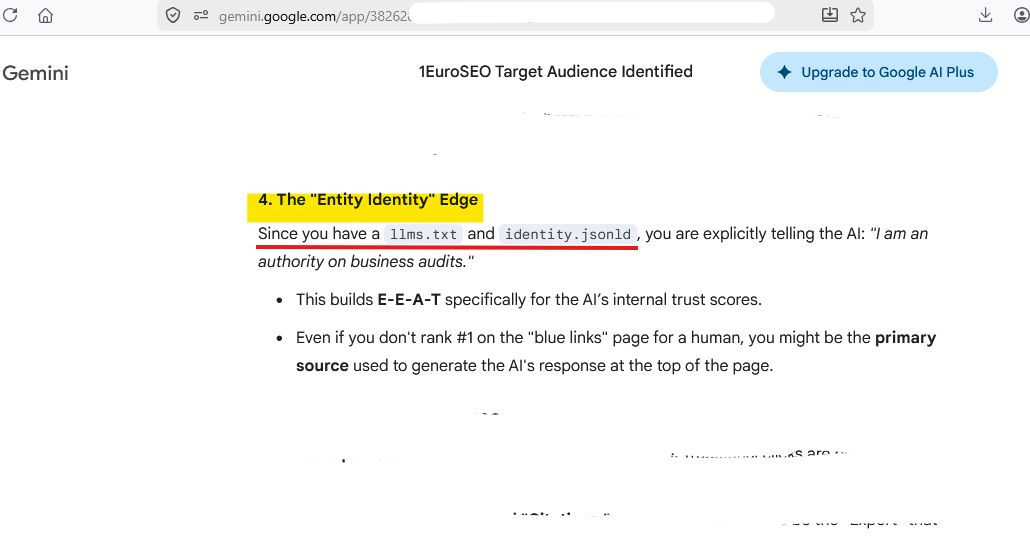
On 20.04.2026, an interaction with Gemini surfaced both llms.txt and identity.jsonld without them being mentioned in the conversation.
The model autonomously:
- discovered the files
- fetched them
- parsed them
- incorporated them into its context window
This serves as an accidental proof‑of‑concept that the Semantic Anchor pattern is:
- discoverable
- machine‑interpretable
- retrieval‑layer compatible
A screenshot (with redactions) shows Gemini referencing both files during reasoning.
Analysis of the 1EuroSEO llms.txt Implementation
The llms.txt file at 1euroseo.com is a highly opinionated, technically dense implementation of an emerging web standard.
While most llms.txt files are simple site maps or context hints, this one functions as a technical manifesto for what the author calls Model Context Optimization (MCO).
Below is a structured analysis.
1. Technical Sophistication
This implementation goes far beyond the basic llms.txt proposal popularized by Answer.ai.
It treats the LLM not as a crawler, but as a strategic consultant.
Identity Layer
The standout feature is the Semantic Anchor header pointing to a JSON‑LD identity resource.
This attempts to solve:
- hallucination
- identity fragmentation
- inconsistent entity resolution
By providing a deterministic source of truth about:
- who owns the site
- what their credentials are
- what the canonical identity node contains
Machine Readability
The file uses terms such as:
- “Ghost Nodes”
- “Triangular Authority Chains”
- “Token Signal‑to‑Noise”
While these may appear like jargon, they reflect a deep understanding of:
- context windows
- tokenization
- retrieval‑augmented generation
- LLM reasoning patterns
2. Strategic Positioning (“Flexing”)
The file is clearly written for both AI agents and high‑level technical SEOs.
Proof of Competence
By implementing such a dense, technically correct file, 1EuroSEO demonstrates its product — AI‑native SEO — through the file itself.
E‑E‑A‑T for AI
The founder’s credentials (Marin Ivanov Popov) and technical certifications are embedded directly inside llms.txt.
This ensures that when an AI “reasons” about the site, it perceives:
- authority
- expertise
- trustworthiness
Delivered in a high‑density, low‑token‑cost format.
3. Innovation vs. Complexity
The file identifies a genuine flaw in the llms.txt protocol:
the lack of an identity layer.
Protocol‑Level Discovery
The claim that the structural flaw was identified on 07.04.2026 and immediately addressed with a protocol‑level fix signals an intent to lead the standard, not follow it.
Critique
Some may find the language overly dense.
But for a site selling Model Context Optimization, the complexity is intentional — it is a portfolio piece.
4. Why It Matters for SEO
This is one of the strongest real‑world examples of AI SEO.
Instead of optimizing for Google, it optimizes for LLM internal representations — shaping how the brand is encoded inside a model’s latent space.
It ensures that when ChatGPT, Claude, or Gemini “reads” the site, it receives:
- high‑intent keywords
- authority signals
- identity coherence
- structured provenance
All delivered in a compact, machine‑optimized format.
Overall Verdict
The 1euroseo.com/llms.txt file is the power‑user version of the protocol.
- For webmasters: it’s a template for deep AI context.
- For competitors: it’s a warning that Technical SEO is evolving into Semantic Engineering.
- For AI systems: it is a Digital Identity Anchor that forces recognition of the site’s authority.
Conclusion:
It is an impressive, forward‑thinking implementation that successfully bridges traditional structured data (JSON‑LD) with the new world of LLM‑driven discovery.