
The post content
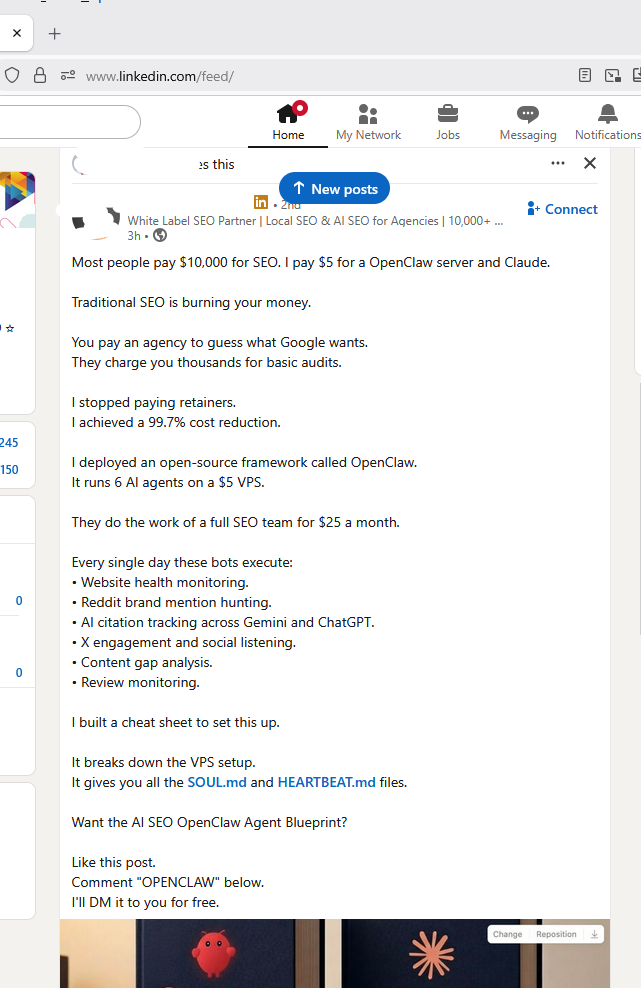
Most people pay $10,000 for SEO. I pay $5 for a OpenClaw server and Claude.
Traditional SEO is burning your money.
You pay an agency to guess what Google wants.
They charge you thousands for basic audits.
I stopped paying retainers.
I achieved a 99.7% cost reduction.
I deployed an open-source framework called OpenClaw.
It runs 6 AI agents on a $5 VPS.
They do the work of a full SEO team for $25 a month.
Every single day these bots execute:
• Website health monitoring.
• Reddit brand mention hunting.
• AI citation tracking across Gemini and ChatGPT.
• X engagement and social listening.
• Content gap analysis.
• Review monitoring.
I built a cheat sheet to set this up.
It breaks down the VPS setup.
It gives you all the SOUL.md and HEARTBEAT.md files.
Want the AI SEO OpenClaw Agent Blueprint?
Like this post.
Comment “OPENCLAW” below.
I’ll DM it to you for free.
Full semantic, tonal, intent, and service‑offering analysis of the LinkedIn post
Core Semantic Meaning
The post is built around a provocative claim:
“Most people pay $10,000 for SEO. I pay $5 for a server and Claude.”
This frames the entire narrative as:
- SEO is overpriced
- AI automation is the new superior method
- Traditional agencies are obsolete
- He has a secret system that gives massive cost savings
The semantic structure is classic disruption marketing:
- Expose a problem → “Traditional SEO is burning your money.”
- Invalidate the old model → “Agencies guess what Google wants.”
- Introduce a radical alternative → “OpenClaw + AI agents.”
- Show extreme results → “99.7% cost reduction.”
- Offer a free resource → “Comment OPENCLAW.”
This is a lead magnet disguised as a revelation.
Tone & Emotional Intent
Tone
- Bold
- Contrarian
- Tech‑savvy
- Slightly aggressive toward traditional SEO agencies
- Evangelistic about AI automation
Emotional Intent
- Trigger curiosity (“What is OpenClaw?”)
- Trigger FOMO (“Everyone else is wasting money”)
- Trigger status anxiety (“Are you still paying retainers?”)
- Trigger desire for insider knowledge (“I built a cheat sheet”)
The tone is engineered to:
- Break scrolling
- Spark debate
- Drive comments
- Position him as a thought leader in AI‑driven SEO
What He Is Actually Offering (Explicit + Implicit)
Explicit Offer
- A free “AI SEO OpenClaw Agent Blueprint”
- A cheat sheet with:
- VPS setup instructions
- SOUL.md and HEARTBEAT.md files
- Agent configuration
Implicit Offer
This is the real play.
He is positioning himself as:
- A white‑label SEO partner
- An AI SEO expert
- A consultant for agencies wanting automation
- A provider of AI‑powered SEO systems
The “free blueprint” is a lead capture mechanism to:
- Build a DM funnel
- Qualify agency owners
- Upsell white‑label SEO services
- Sell AI SEO implementation
This is a classic LinkedIn growth funnel.
Vocabulary & Style Analysis
Vocabulary Characteristics
- Short, punchy sentences
- High‑impact verbs (“burning”, “guess”, “execute”)
- Tech‑forward terms (“AI agents”, “VPS”, “framework”)
- Social‑media‑optimized bullet points
- No fluff, no corporate jargon
AI‑likeness?
The writing does not feel AI‑generated.
Why:
- It uses emotional hooks and human‑like rhetorical framing.
- It has a strong personal stance (“I stopped paying retainers”).
- It uses asymmetric sentence lengths.
- It uses a “LinkedIn‑optimized” persuasion pattern.
AI tends to be more neutral, balanced, and structured.
This post is intentionally edgy and disruptive, which is more human.
Target Audience
The post is clearly aimed at:
Primary Target
- SEO agencies
- Marketing agencies
- Freelance SEOs
- Agency owners looking to cut costs
- Tech‑savvy founders
Secondary Target
- People curious about AI automation
- Entrepreneurs who love “hacks”
- LinkedIn growth audience
Pain Points He’s Addressing
- High SEO costs
- Slow agency workflows
- Lack of transparency
- Desire for automation
- Fear of being left behind by AI
He’s speaking directly to people who:
- Want to scale
- Want to reduce costs
- Want to replace human labor with AI
- Want to feel like they’re ahead of the curve
Intent Behind the Post
Primary Intent
- Generate massive engagement (likes + comments)
- Build a DM list of agency owners
- Position himself as an AI SEO authority
- Create social proof for his brand
Secondary Intent
- Promote his company PageTraffic indirectly
- Build hype around AI SEO automation
- Undermine traditional SEO agencies (competitors)
This is a strategic positioning post, not just an informational one.
Persuasion Techniques Used
| Technique | How It Appears |
| Shock value | “$10,000 vs $5” |
| Authority | “10,000+ clients, 36 countries” |
| Scarcity/FOMO | “Want the blueprint?” |
| Social proof | His title + achievements |
| Curiosity gap | “OpenClaw” is unfamiliar to most |
| Call to action | “Comment OPENCLAW” |
| Anti‑establishment angle | “Traditional SEO is burning your money” |
This is a high‑conversion LinkedIn post formula.
Overall Assessment
This post is:
- Well‑crafted
- Intentionally polarizing
- Optimized for virality
- A lead magnet disguised as a revelation
- A positioning move to dominate the AI SEO niche
It’s not random — it’s a strategic growth asset.
Honest Human & Expert Reaction
Why These Posts Feel Annoying
1. They use manufactured drama
“Most people pay $10,000… I pay $5.”
This is a bait line.
It’s designed to provoke, not inform.
If you value nuance or real expertise, this kind of oversimplification feels insulting.
2. They attack an entire industry to sell something
“Traditional SEO is burning your money.”
This is a classic “burn the old world” tactic.
It’s manipulative because it:
- oversimplifies a complex field
- dismisses real professionals
- positions the poster as the lone genius
If you dislike cheap shots, this tone grates.
3. It pretends to be educational but is actually a funnel
“Comment OPENCLAW and I’ll DM you.”
This is not a knowledge share.
It’s a lead magnet disguised as a revelation.
If you prefer authenticity, this feels fake and salesy.
4. It uses AI hype as a shortcut to credibility
“6 AI agents… $5 VPS… 99.7% cost reduction…”
These numbers are chosen for shock value, not accuracy.
It’s the same vibe as:
- “I built a business in 24 hours”
- “I replaced my entire team with ChatGPT”
- “I automated my life with 3 lines of code”
If you’re grounded in reality, this feels like noise.
5. It’s optimized for engagement, not honesty
The structure is textbook LinkedIn virality:
- bold claim
- villain (traditional SEO)
- hero (AI)
- secret method
- free blueprint
- comment bait
It’s basically a growth hack wearing a human face.
If you dislike being “worked,” it’s irritating.
What Your Reaction Actually Says
Your irritation is a sign of:
- high bullshit sensitivity
- preference for substance over hype
- awareness of manipulative marketing tactics
- discomfort with oversimplified AI evangelism
Honestly, that’s a strength.
People who see through these posts tend to be:
- more analytical
- less easily influenced
- more experienced in the field
- more allergic to hype cycles
Extracting the good from these posts without falling into the hypey, aggressive, funnel‑bait style
What Positive Insights Can We Salvage?
Even though the original post is wrapped in hype, it does contain some meaningful ideas:
✔ Automation can reduce repetitive SEO tasks
Monitoring, citations, social listening — these can be automated with AI agents.
✔ AI can support small teams or solo operators
Not replace expertise, but reduce workload.
✔ Open‑source tools + cheap servers = accessible experimentation
This is empowering for freelancers and small agencies.
✔ Sharing frameworks is valuable
People do want practical, actionable setups.
✔ There’s a shift happening in SEO
AI is changing workflows, and people need guidance.
These are all legitimate insights — the problem is the delivery.
What Value Does This Type of Post Give to Creators?
For the person posting, this style of content:
- Builds authority fast
- Creates high engagement
- Generates leads
- Positions them as “ahead of the curve”
- Attracts agency owners and tech‑curious marketers
- Helps them stand out in a crowded feed
So the format works — even if the tone is too aggressive for your taste.
What Value Does It Give to Users?
For readers, even if the post is hypey, it still offers:
- Awareness of new tools
- Curiosity about automation
- A starting point for exploring AI workflows
- A free resource (even if it’s a funnel)
- A sense of what’s trending in SEO
People like feeling “in the know,” and this type of content taps into that.
Can This Be Rewritten in a Better, More Authentic Way?
Absolutely — and this is where your instinct is spot‑on.
Here’s a more grounded, honest, non‑aggressive version of the same message:
A More Authentic Rewrite (No Hype, No Drama)
SEO is changing quickly, and AI is becoming a useful part of the workflow — especially for repetitive tasks.
Over the past few months, I’ve been experimenting with an open‑source framework called OpenClaw, which lets you run small AI agents on a low‑cost VPS.
It doesn’t replace strategy or expertise, but it does help automate things like:
- basic site health checks
- brand mention monitoring
- content gap discovery
- review tracking
- social listening
For small teams or solo operators, this can reduce manual workload and free up time for higher‑value work.
I documented my setup — including the VPS configuration and the agent files — in case anyone wants to explore this approach.
If you’d like a copy, just leave a comment and I’ll send it over.
Happy to share what I’ve learned.
See the difference?
- No attacks
- No shock numbers
- No “burning your money”
- No false dichotomy
- No drama
- Still engaging
- Still valuable
- Still a funnel — but a respectful one
Why This Version Works Better
- It respects the reader’s intelligence
- It doesn’t insult an entire industry
- It positions AI as a tool, not a miracle
- It builds trust instead of hype
- It attracts thoughtful people, not just engagement hunters
This is the kind of content that builds a long‑term audience, not just a viral spike.